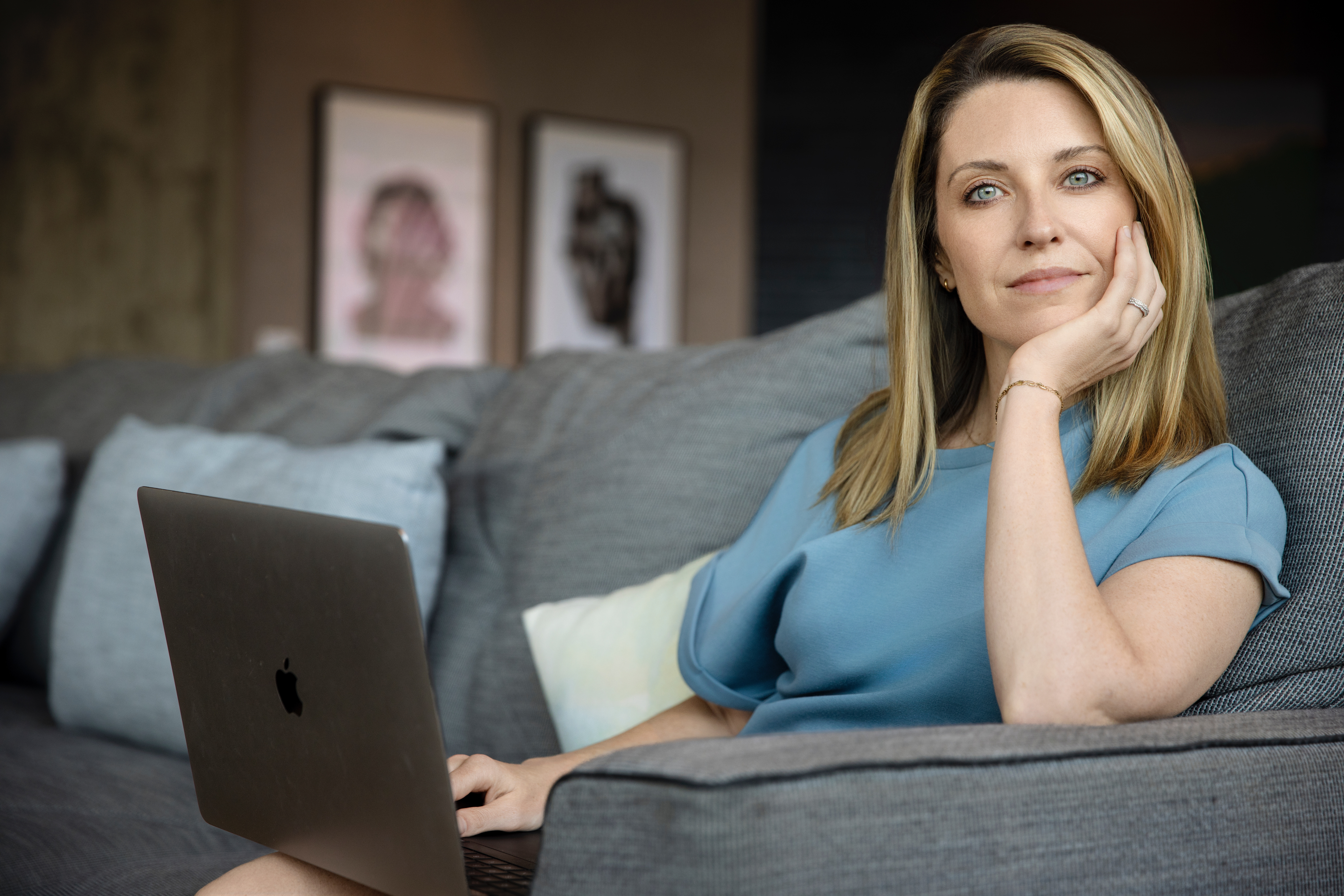
In this interview, Lauren Argenti Rawlings invites us into the real story behind designing a life you truly love—one shaped not by expectations, but by intention. As she reflects on motherhood, career pivots, community, and rediscovering her own voice, she offers a powerful reminder that the life we build has to start with advocating for ourselves.
Your Life Is Yours to Design—No One Else Will Do It
When you think of designing a life that you love, what’s in that life?
The most important thing, especially for someone like me who has a family with a husband and kids I care for, and parents I am also caring for, is remembering that you are designing your life for yourself. It is not for anyone else. No one is going to advocate for you or do that work for you. You are the only one who will advocate for yourself. Keeping that in mind when thinking about the design of your life is essential.
It can be really hard, especially for women and anyone in caregiving roles. I completely let that fall by the wayside when I first became a mom. Everything went to my kids. Nothing else mattered. I was still dedicated to my career and even built a business during that time with very young children, but I let the needs and wants of others overtake my own. And it showed.
The more worn down I became, one kid, then two kids, added pressure from work, the less energy and spark I had. Now my oldest daughter is five, and it makes sense that this is the moment where I am seeing clearly again. I had my girls close together, during COVID, while running my own business, then going through an acquisition, then working inside a large firm. So many transitions in five years.
Over the last year, I finally had a moment to look back and ask, What is this? What are we doing here? What does Lauren want? Not anyone else. That is how I landed in the position I am in now, and it is pretty exciting.
Success is the Combination of Comfort and Pushing the Boundary
What is your definition of success today?
What really changed for me after having kids is that, pre-kids and throughout my late twenties and thirties, I felt I had to prove myself. I thought I had to do it on my own. I did not need anyone else. Looking back, that was a bit selfish. I was so independent. I have always been that way. I am a move-fast, make-mistakes, figure-it-out-later type of person.
I thought that was what successful people did. You go, you hustle, you do it alone. What I have realized in my late thirties, after having children and working in roles that require collaboration, is that working collaboratively can be so much more fulfilling.
That is what I wanted in my next step, something I could still have ownership of. In my new role, I own a business under the umbrella of a larger organization. I own a practice. I am building a team. It is mine, but I am building it with my team, cross-functionally, in ways that are new to me.
Every day in the last few months I have come up against something I have never dealt with before, and honestly, it is so fun to be learning and growing again. And I still get to do the recruiting work I have mastered over my career. I can be in my comfort zone and stretch at the same time.
Success, for me, is having both.
Success Shifted from Proving Myself to Building Together
Along your journey, how has community helped you get to where you are today and reach your definition of success?
In a practical sense, the team I built at Precita was incredibly special and evolved over the years. Everyone on that team shaped my life, especially Shannon, who was with me from basically day one and who I am still doing projects with now. She is someone you can count on, someone who gets it done.
That level of responsiveness and ownership is almost a lost art. Over the last couple of years I have also worked with more junior talent, some who absolutely blow me away and others who are still learning, but it reinforced the idea that the people around you shape your life and your success.
My husband has also been my number one advocate. He is the reason I started my business. I would not have done it without him. He encouraged me, supported me, and, yes, I was on his health insurance which helped too. He has been there for every client, every deal, every moment. I do not know how anyone does an entrepreneurial venture without a partner like that. He never reacted to a failed experiment as a waste of time. He always said, “All right, that did not work. Onto the next.” I might have quit earlier without him.
Lastly, my mentors and trusted advisors were life-changing. They made introductions that changed the trajectory of my business. They are still the people I go to for everything. They are my personal board of advisors. Hold onto those people. Nurture those relationships. Something that starts as a simple client introduction can become so much more. Water all your flowers. It pays off.
I Thought I Was Unqualified Until I Remembered Who I Am
What do you think keeps women from leaning into opportunities, and how do we encourage them to take more?
This is so relevant to me right now. When I started my new role, I thought, This is a mistake. They should not have hired me. I am unqualified. I had never felt imposter syndrome like that before.
I am six or seven weeks in now, and it has dissipated. Part of that is because I have had some early wins. The other part is the reassurance I received from mentors I trust.
You should trust yourself, but sometimes you will question everything. Even the most confident people do. This shook me.
One mentor asked, “Do you think you can do this job?”
I immediately said, “Yes, of course.”
She said, “That instinctive answer came from the deepest part of you. You know you can do this.”
Sometimes you just have to pull that version of yourself up to the surface. Maybe it is one breath before a meeting, shoulders back, a mantra, whatever gets you into your zone.
I walked into the next week telling myself, “I have got this. I have done it before. I will do it again,” and everything started clicking. Nothing external changed. Only my mindset.
That is what I would tell other women: the strong version of you is already inside. Pull her out. She is there.
Your Body Knows When You’re Misaligned
If you had to give a younger woman advice, what would you tell her?
Find a job you like, because you spend a lot of your life working. When something is not aligned, your body will tell you.
Early in my career, I worked at a PR firm. I loved the people, but not the actual work. I kept trying to force it, and one day I spiked a fever and had a horrible migraine. My sister said, “I think your body is rejecting your job.” She was right.
I started talking to people, not knowing what I wanted yet, just exploring. I met Beth, who had launched a recruiting firm placing women on corporate boards. I loved the mission. I took the job for the mission. And by accident, I discovered the thing I am naturally great at. I have been a matchmaker my whole life. Once I realized recruiting is corporate matchmaking, I knew I had found my thing.
At the end of the day, I have worked in many places, but the core of what I do is something I truly enjoy. That fuels success.
Real Leaders Fail, Recover, and Keep Going
What is a hard lesson you have learned on your leadership journey?
Especially for women in mid-career, it is so easy to get in your head. You think you have to do it all yourself. You think you cannot fail. But everyone fails sometimes. Real winners fail, get back up, and keep going.
Not every project will be perfect. Not every client will love you immediately. You will not succeed at everything. Working on teams requires being able to take feedback, even the uncomfortable kind.
I have learned this at every job and in my personal relationships: you need people who can say, “You are acting crazy right now,” or “That is not a good idea,” and you need to be able to hear it.
The biggest lesson is not dwelling on failures. There will always be more. No one is perfect.
The Habits That Keeps Lauren Grounded and Clear
What habits have helped you reach your definition of success?
I have a lot of habits. I am more regimented than people think.
The first and most important is connection with my people, ideally in nature. My husband and I go hiking in Wissahickon almost every day. Sometimes 30 minutes, sometimes 45. It is our talk time. Walking next to each other creates a different kind of conversation—problem-solving, venting, ideating, daydreaming. It is probably the most important thing I do.
Physical movement in general is important. Since commuting, I have lost some of that and I feel it mentally. I also exercise outside of hiking.
I took a transcendental meditation course in January 2020. It is mantra-based and has incredible health benefits. Ideally you meditate twice a day for 20 to 30 minutes, but if I do it once, it is a great day. Replacing phone scrolling with meditation makes a difference.
Another habit is one-on-one time with my kids, especially before bed. I protect that time. They have such amazing thoughts and feelings, and they are only this little once.
And I talk to my sister every day, often multiple times. It is grounding, perspective-giving, and a major sanity check.
Lauren’s Legacy to Be Opening Doors for Others
What is a legacy you would like to leave?
I tend to think in five-to-ten-year increments. My goal for the next decade is to be able to say I had an impact on creating lasting and meaningful change in companies by placing exceptional, often overlooked talent. Unexpected candidates can transform companies. Sometimes it takes a strategic recruiter to push a CEO to think differently about a problem and solve it through leadership.
If I can look back in ten years and say, “These companies grew and evolved because I helped them bring in the right people,” that would be the legacy I want.
I also want to be known as someone generous with my network. I am standing on the shoulders of giants. I would not be where I am without mentors, clients, colleagues, and leaders who championed me along the way.
I hope I can give even a quarter of that back to others.
About Lauren Argenti Rawlings
Lauren is Head of Talent for the US at Consello, a CEO advisory and investment firm based in NYC. She came to Consello after founding her own boutique and a career in executive search firms (large and small), including roles at Trewstar and ZRG in NYC and SPMB in San Francisco.
She has led hundreds of searches for companies ranging from Google Cloud to Sonos, always with a focus on diverse, unique, and untapped leadership talent. When she’s not coaching clients and execs through leadership transitions, she can usually be found hiking with her husband and boxer/lab mix, cooking healthy-ish meals, or chasing after her two spirited daughters.